
Baking-soda volcano
Vinegar and baking soda make a gas (bubbles) that can push liquid up and out of a glass.
Grab bag
Kitchen first. If you're missing something, these are the pieces that worked at our table.
- Dish soap (small squeeze)
- Spoon
- Towels
Opens Amazon with these items ready to add — you confirm the cart.
- Baking sodaArm & Hammer Baking Soda, 1 lb
~3 Tbsp per round (eyeball).
- White vinegarHeinz Distilled White Vinegar, 1 gallon
Plain white is easiest to clean (no sugar/dye). Any white vinegar works.
- Food coloring365 Plant-Based Food Coloring (4 bottles)
Optional color for the foam.
To pour into a bottle opening — not as the volcano itself.
- Tall clear glassLibbey City Tumbler glasses (14.3 oz, set of 8)
Tall clear vessel. You only need one.
Rimmed sheet under the volcano. Any tray with sides works.
The moves
 1
Glass + baking soda
Glass on tray; ~3 Tbsp baking soda (eyeball).
 2
Dish soap + color
Small squeeze of dish soap, then food coloring. He pours both.
 3
Vinegar pour
~1 cup vinegar (eyeball). Watch the fizz climb and overflow.
- 4
Reset and save the last for the kid
Reset and repeat. Save the last “everything” pour for the kid.
Kid verdict
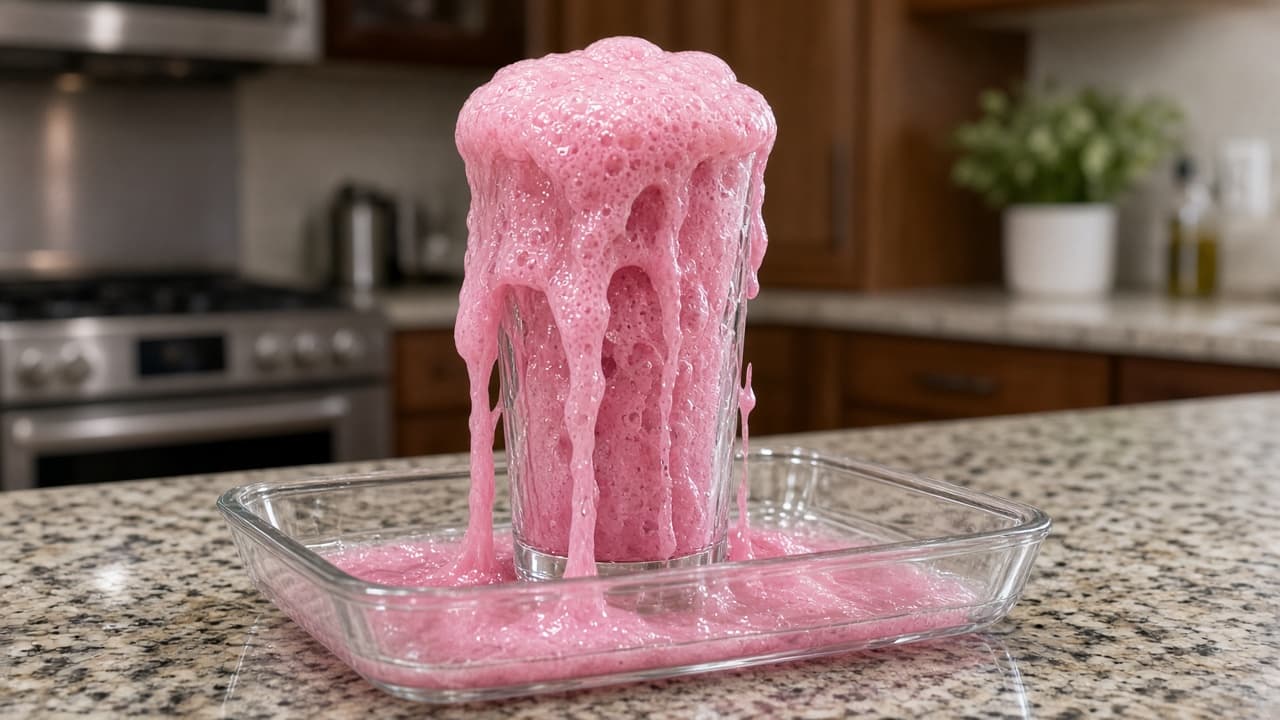
Tonight the 3yo asked to do more volcanos — we did; he liked it. The 1yo was screaming (happily) at every eruption. Best was a tall transparent glass on a glass tray. He pours dish soap and coloring after the baking soda. He loved it — especially the last run with everything: all the color, all the vinegar, all the baking soda. Trying the funnel as the volcano didn’t work well; funnel is helpful to pour. Recipe each time: ~3 tablespoons baking soda, a small squeeze of dish soap, ~1 cup vinegar (a little eyeball). Let the kid do it at the end. Went through a bottle of white vinegar and baking soda. Any vinegar would probably work, but pure white vinegar doesn’t have sugar or color — easier to clean. Tried a baby bottle — works well with the opening a little smaller than the base.
Bear with me
The orange arrows in both panels are dashed. Dashed means something is moving (here, bubbles and foam going up), not a push.

Panel 1, "Acid + baking soda → CO₂ gas". On the left is the glass on the tray. The baking soda is in the bottom, vinegar is pouring in from the cup, and the first bubbles are already showing at the powder. The circle is a magnifier. The big window on the right is that spot, zoomed way in. It is not to scale; the grains and bubbles are drawn big enough to see.
The cream chunks sitting on the bottom are baking soda grains. Baking soda is sodium bicarbonate. The pale blue all around them is the vinegar: mostly water, with a weak acid dissolved in it, acetic acid. That is why the label says "vinegar (water + acid)".
When the acid touches a grain, it hands the bicarbonate a hydrogen ion (a proton, H⁺). The piece that makes is carbonic acid, and it is unstable. It falls apart right away into water and carbon dioxide. That is the panel 1 caption: "The result (carbonic acid) splits into water + CO₂."
At first that CO₂ is dissolved in the liquid, like the fizz in a closed soda bottle. Very quickly there is more than the liquid can hold, so it comes out as bubbles. Bubbles start most easily on rough surfaces. Look where the white bubbles are in the zoom: sitting on the grains ("new CO₂ bubble"). Bubbles pop out all over the powder, on the grains' rough surfaces, within a few seconds.
When a bubble gets big enough, it lets go and rises. That is what the short dashed arrows pointing up show. The gas is carbon dioxide: the same molecule as the bubbles in soda pop, and part of what we breathe out.

Panel 2, "Foam = liquid stretched around gas". On the left, the glass has filled with foam. It domes over the rim and runs down onto the tray (the dashed arrow: "foam climbs"). At the very bottom of the glass, under the foam, there is a thin layer of clear liquid. That is liquid that has already drained back down out of the foam. The zoom on the right is a piece of that foam at the rim.
Look at what the foam is made of. Big white bubbles of CO₂ gas crowd together in the liquid. Where two bubbles nearly touch, the liquid between them is only a thin wall ("thin liquid wall"). That liquid is the same liquid that was in the glass: vinegar water, with the leftovers of the reaction dissolved in it. Nothing new and gooey was made. The same liquid got stretched around a lot of gas.
Gas takes a lot of room. With this recipe the reaction makes about ten times the glass's volume in gas, so the foam has to climb the glass and spill onto the tray. Nothing “turns into lava.”
The circle at the top right of that zoom zooms in once more, onto one wall: "water" in the middle, "gas" on both sides. The little green dots with tails, lined up on both faces, are the "soap molecules". Each one has its head in the water and its tail sticking out into the gas. That is all the dish soap does. It makes no extra gas. It sits on the walls and helps them last before they pop, so the foam gets thicker and climbs higher.
So, in one line: an acid–base reaction (bicarbonate + acetic acid) makes carbon dioxide gas inside the liquid, and the liquid gets stretched into foam around it.
Numbers
Reaction: NaHCO₃(s) + CH₃COOH(aq) → CH₃COONa(aq) + H₂O(l) + CO₂(g). In words: bicarbonate + acetic acid → acetate salt + water + carbon dioxide gas. The gas is what you see as fizz and foam. With this recipe (3 Tbsp baking soda, 1 cup vinegar) the vinegar runs out first and makes about 5 litres of CO₂, around ten times the volume of the glass. That's why it has to come over the top.
Go deeper
Touch the glass: it gets a few degrees cooler, because this reaction soaks up heat. The gas itself is invisible and has no smell; the sharp smell is the vinegar. The spill is leftover liquid + bubbles. Dish soap does not make more CO₂ — it helps bubbles last longer so the foam looks thicker (surfactant). Grocery white vinegar is usually about 5% acetic acid (roughly 5 g per 100 mL); the rest is water. That is plenty for this demo.
Try it: which runs out first?
Pick how much baking soda and vinegar go in, pour, and see which one runs out first.
Heads-up
Use grocery vinegar (5% acid), not cleaning vinegar (8–14%). Cleaning vinegar stings eyes much worse.