
Cinnamon soap rush
Soap can weaken the “skin” on water so floating powder suddenly rushes away.
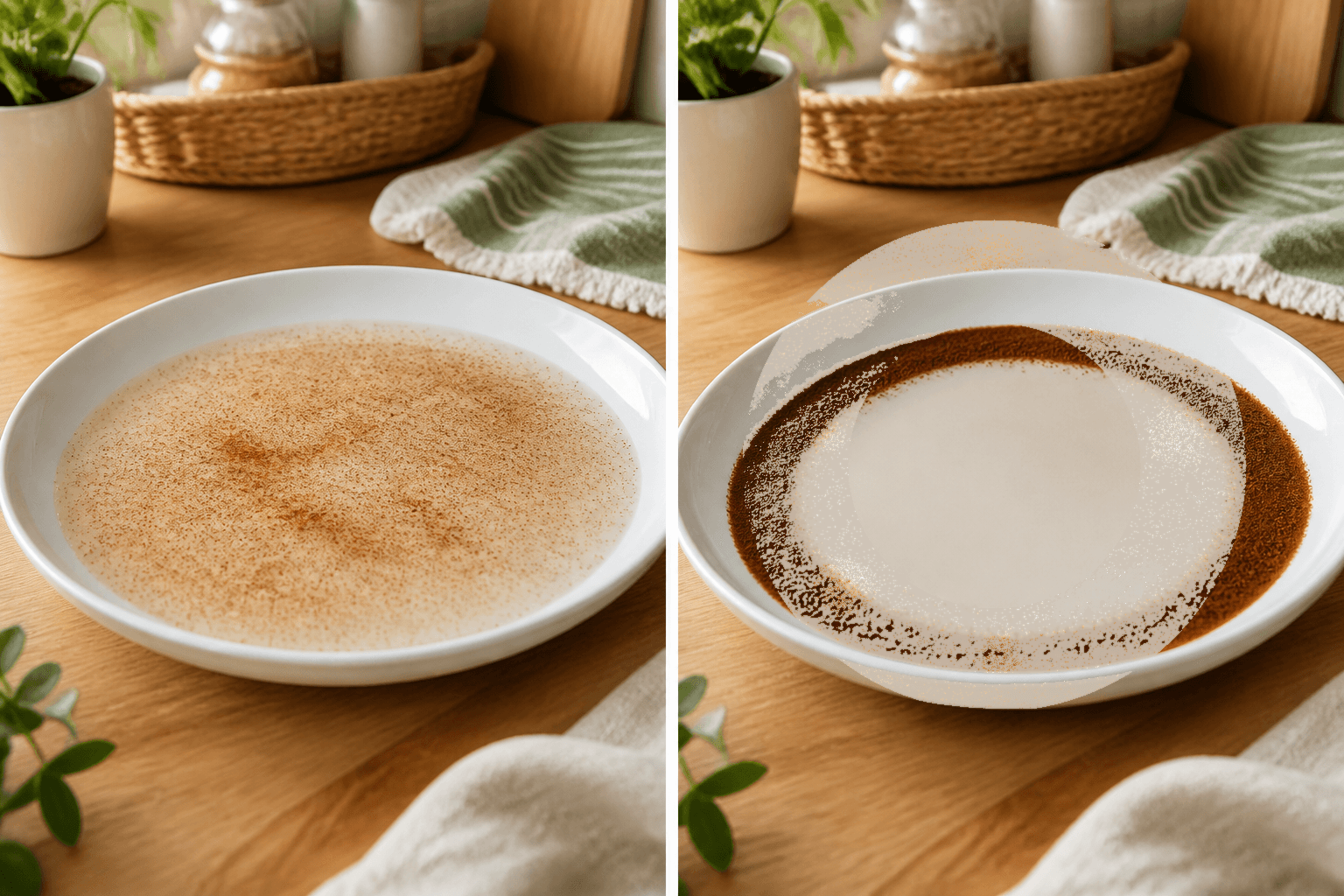
The experience
Fast payoff, easy redo — cinnamon races to the edges.
RUN THIS
How to run it
Thin water, cinnamon dust, one soap touch at the center, optional redo.
Steps
- 1
Thin water layer
Pour a thin layer of water on the white plate.
- 2
Dust the surface
Sprinkle cinnamon evenly so it floats on top.
- 3
Soap touch
Dip a swab in dish soap; touch the center once — cinnamon rushes outward.
- 4
Optional redo
Dump and rinse the plate well. Any soap left on it and the second run does nothing.
Bear with me
Mechanism
This one happens in half a second, so the sketch slows it down. For the arrows: solid orange arrows are pulls (forces), and dashed ones show which way something moves.

Panel 1, "BEFORE: stretched skin". On the left is the plate: a thin layer of water with cinnamon floating on top. The circle is a magnifier, and it zooms way, way in, all the way to the water molecules ("zoom: water molecules"). A cinnamon speck would be enormous at that scale, so it is left out of the zoom.
Each blue ball is a water molecule. Water molecules pull on the neighbours right next to them. Notice the top row is just as jumbled as the rest. There is no special tidy layer at the surface.
Look at the one marked "inside: balanced". It has neighbours all around it, so its pull arrows go every way and cancel out.
Now look at the one right at the top, "surface: none above, net pull in". It has neighbours beside it and below it, but none above (that's air). So its pulls don't cancel. The sideways ones balance each other, and what is left over is a pull inward, into the water: the bigger arrow down.
Every molecule along the top is like that: tugged inward, with fewer friends than the ones below. (The molecules underneath push back, so nothing sinks.) So water tries to keep as few molecules at the surface as it can. It pulls its surface as small and tight as possible, like a stretched skin ("acts like a stretched skin"). That tightness is surface tension. Floating cinnamon just sits on that skin.

Panel 2, "SOAP: the skin pulls away". On the left is the plate seen from above, a second after the soap touch. The green dot in the middle is the soap. The dashed arrows point outward from it: the surface is moving out, and the cinnamon has already been carried out toward the rim.
The window on the right is a side view cut straight through the soap spot: soap molecules in the middle, clean water on both sides. The green balls with tails sitting on the surface are "soap molecules". Soap is a surfactant: it sits at the surface and weakens the pull there.
Now look at the two black squares, one at each edge of the soap patch, right at the soap front. Each one is a little bit of surface caught in a tug of war. The short solid arrow pointing back over the soap is the pull from the soapy side: "weak". The long solid arrow pointing out is the pull from the clean water: "strong". Strong wins, so the surface slides away from the soap spot, on both sides.
The dashed arrows under the surface are the moving surface dragging the water just under it along: "surface slides out, dragging water". The cinnamon rides on top of that moving surface, all the way to the edges. Nothing pushes the cinnamon: not air, not the soap. The water's surface moves and carries it. (Where does that water come from? It wells up from underneath the soap spot, and a slow return flow creeps back along the bottom.)
Numbers
One tiny drop is enough. Once soap coats the whole surface, the skin is weak everywhere, so extra soap has nothing stronger to pull against. Clean water's skin pulls with about 72 millinewtons per metre; soapy water only about 25–35. That's roughly half to a third as strong: a big lopsided tug.
Notes from home
This was our first one. He just wanted to do it over and over. He tried adding soap to a plate that was already soapy, and it didn't work. He's asked to do it again many times.