
Cornstarch thickening fluid (Maïzena)
Some mixes feel liquid when you pour slowly and solid when you poke or squeeze hard.
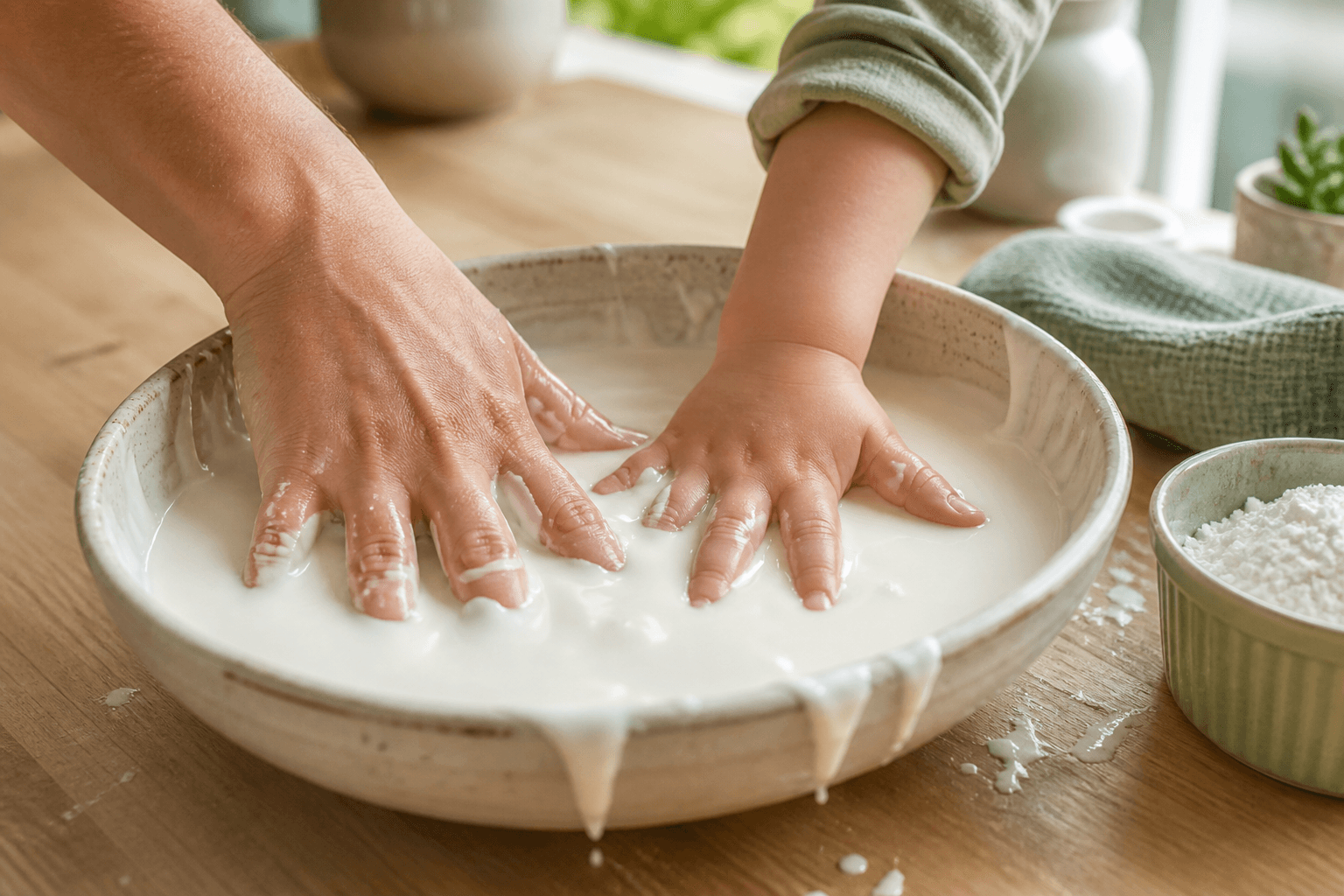
The experience
Pours like a liquid, then goes firm when you slap, smash, or squeeze it. Very messy; very easy to clean. Both at the counter (learning tower + high chair), shirtless, sticks in stainless bowls.
Grab bag
Kitchen first. If you're missing something, these are the pieces that worked at our table.
Opens Amazon with these items ready to add — you confirm the cart.
- Maïzena (cornstarch)Fleischmann's Canada Corn Starch, 1kg/2.2 lbs
Pure cornstarch, ~1 kg. Spoon until firm poke / slow drip. (Argo 35 oz B0045DMLXM had no offers.)
- Wide bowl or tray (stainless works)Nordic Ware Baker's Half Sheet
Rimmed sheet under the bowl. Any tray with sides works.
- Optional: food coloring365 Plant-Based Food Coloring (4 bottles)
Optional color. Same pack as the volcano.
RUN THIS
How to run it
Water first, then spoon Maïzena until it feels fun.
Steps
- 1
Water + tools
Shallow water in a wide bowl (stainless is fine). Cups and wooden sticks or smash toys nearby. Learning tower for the bigger kid; high chair keeps the little one in on it.
- 2
Maïzena until fun
Spoon in until it feels fun — firm when you poke, still drips when you pour. No exact ratio. Err toward more cornstarch if you want that solid-ish feel.
 3
Pour vs smash
Slow pour flows; fast smash feels firm. Mix pools flat in the bowl; splatters on the counter hold as thick blobs.
 4
Play
Pour, smash, scoop, slap; squeeze a ball and watch it melt. Steer with water or Maïzena.
Bear with me
Mechanism
This is not a gel, not melted plastic, and not a chemical reaction. You mixed water and billions of tiny hard cornstarch grains. Starch actually likes water: water wets each grain and it swells a little, but each grain stays a tiny hard particle. The grains do not dissolve. They sit in the water as a crowded suspension, a particle slurry.
A note on the arrows: solid orange arrows are pushes (forces), and dashed ones show which way something moves.

Panel 1, "Slow spoon → it flows". On the left is the bowl, with a spoon moving through the mix slowly (the dashed orange "slow" arrow). The circle is a magnifier. The big window is what a tiny patch of the mix looks like zoomed way in. Check the scale bar: 20 µm. A human hair is a few of those bars wide.
Each cream blob is one starch grain: a few to tens of micrometers across, irregular, and stiff. The pale blue is water. Look between the grains. There is a thin water film between neighbours ("water film"). The films are drawn much thicker than they really are, so you can see them. At rest or under a gentle, slow push, that film acts like a lubricant between the grains. There is also a tiny push-apart force between the grain surfaces, and it helps keep them from touching, as long as you don't push harder than it.
The small dashed arrows on the grains show them moving along with the spoon. Grains near the top move the most and lower ones less, so layers of grains slide, roll, and rearrange past each other. Zoom back out and that is the mix pouring and dripping like a thick liquid.

Panel 2, "Fast smash → it jams". Same bowl, same mix. This time a fist comes down fast and hard (the big solid "fast, hard" arrow is the push). Look at the shaded cone under the fist in the bowl. That is the jammed region. It grows from where you hit, down until it reaches the bottom ("jam reaches bottom").
Now the zoom. The push is so hard and sudden that, right where two grains are closest, it pushes through the last whisper-thin film and the tiny push-apart force. The grains touch and rub with friction ("grains touch"). Those are the grains shaded orange.
The rest of the water can't move fast enough to help. To slide past each other, the grains would have to spread apart a little, and water can't flow into the pile that quickly ("water can't escape in time"). So the grains stay pressed together.
The orange lines running through them are force chains: lines of touching grains passing the push along, from the arrows at the top down "to bowl bottom". Once chains reach something firm, like the bottom of the bowl, the pile locks. It feels solid. For that moment it can even crack.
Notice what is the same in both zooms: how crowded the grains are and how much water is there. Same water, same starch. No new material appeared, and the water did not leave. What changed is how hard and how fast you pushed: the rate and strength of the push. (Hydroclusters, grains the flowing water drags into clumps, only explain mild thickening, not this sudden jam. The sketch doesn't draw them.)
Stop pushing and the second line of the panel 2 caption happens: "Stop pushing → they let go → it flows again." The chains fall apart, water films come back between the grains, and it melts back into a puddle. Slow shear → flow. Fast, high shear → jam.
Fluids whose resistance rises when you shear them harder are called dilatant or shear-thickening. Cornstarch + water is a classic kitchen case. (Ketchup and paint do the opposite: they get runnier when you shear them. That is shear-thinning, and it comes from different particle and polymer physics.) At high enough grain loading and sudden stress, the thickening can jump almost discontinuously. A punch is closely related to that jump: a jammed front shoots down from where you hit, and a soft pour becomes a crack. That is why smash toys and slap games feel so dramatic.
How crowded the bowl is matters. If the volume fraction of grains is too low, there is always space to rearrange and you only get a thin sludge. If it is dense enough, a hard hit can jam the whole pile. That is roughly the crowded regime parents hit by feel: firm when poked, still drips when poured. That is why “don’t be scared to put too much cornstarch” works: more grains → easier jamming → a real solid-ish liquid under stress. Too dry and crumbly just needs a splash of water; the target is dense but still wet.
Flour + water usually won't give the same sharp switch. Flour isn't pure starch. Its proteins (gluten) get sticky and stretchy in water and glue the particles together into a paste, so they can't slide freely one moment and lock the next. Pure starch powders (corn, potato) do the trick; flour mostly doesn't.
Walking quickly across a deep tray of the mix (or the backyard-pool demos online) uses the same physics. Each footfall is a fast, high-stress punch that briefly jams a pad under the foot, like the cone in panel 2. Stand still and you sink, because slow loading lets grains rearrange again, like panel 1.
Numbers
No exact kitchen ratio needed. A good starting point is about 2 cups of cornstarch to 1 cup of water (roughly 2:1 by volume; the grains are then about 40% of the volume). Then adjust by feel: firm on a poke, still drips on a slow pour. Dense suspensions that shear-thicken hard are typically packed with a large volume fraction of grains (crowded, not watery). Feel beats measuring cups.
Go deeper
• Squeeze a ball in your fist (firm), then open your hand and watch it melt — jam on, jam off. • Fingertips walking across a tray: quick steps stay up; slow ones sink. • Compare with flour + water (different feel) or plain water (no jam). • Ask: did we make a new substance, or did we change how the same pile of grains rearranges?
Name for this
Shear-thickening suspension, dilatant fluid, frictional jamming / force chains, non-Newtonian fluid, oobleck.
Notes from home
The maïzena was great; very messy very easy to clean. Proportions can be approx — don’t be scared to put too much corn so it becomes a real solid-ish liquid. 1yo loved playing with it with a spoon in a cup. Would scream a lot. 3yo did the mix, had a small bowl, made balls with the mix, made a giant mess and was happy.