
Density Layers
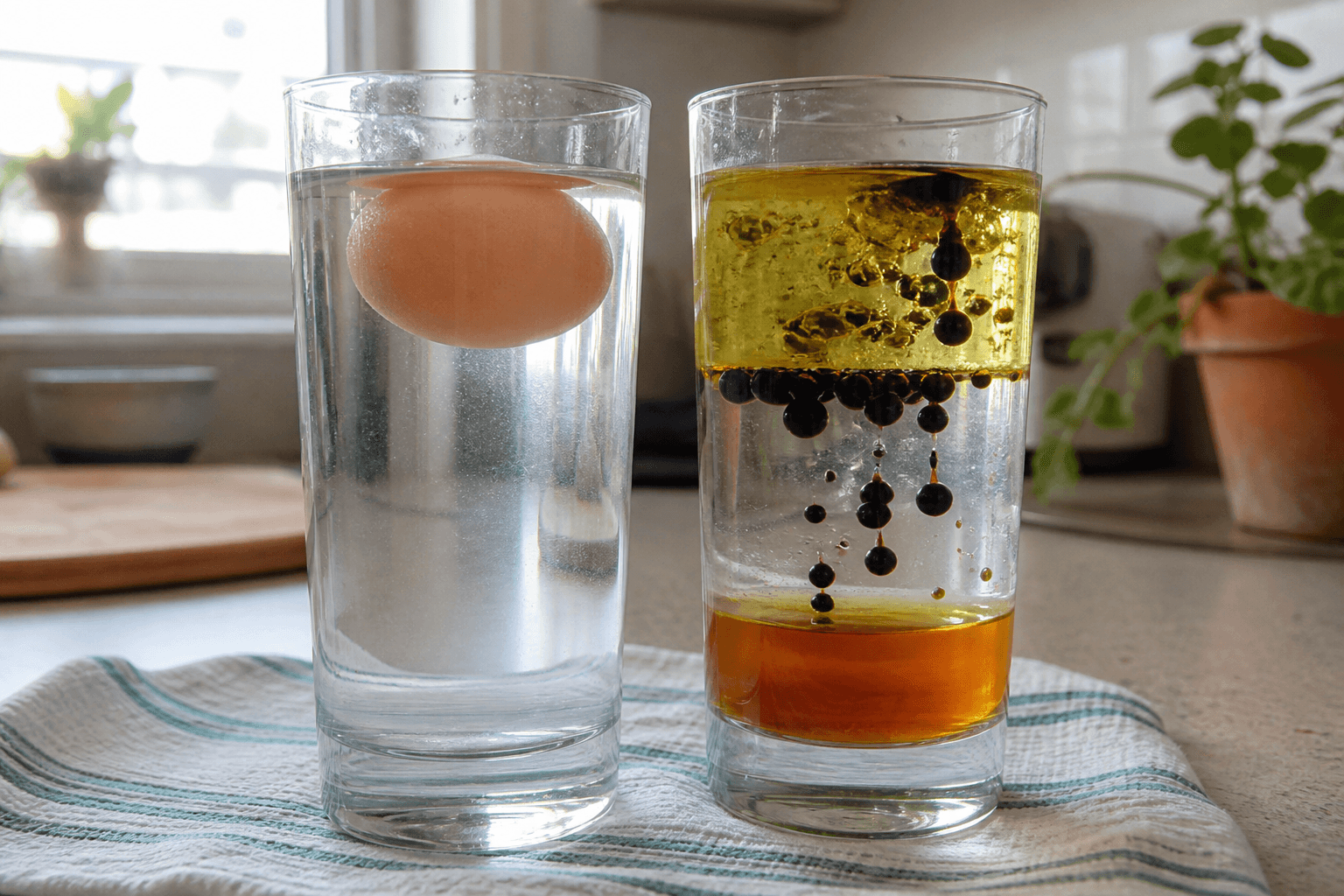
Different liquids stack because some are denser — more mass in the same amount of space. Salt water can hold up an egg. A balsamic drop falls through oil — then the oil it dragged down floats back up.
The experience
The balsamic drops were the real blast. Two seconds of magic when the egg started climbing, then he wanted more salt.
Grab bag
Kitchen first. If you're missing something, these are the pieces that worked at our table.
Opens Amazon with these items ready to add — you confirm the cart.
- 2–4 clear glasses or jarsLibbey City Tumbler glasses (14.3 oz, set of 8)
Tall clear vessel. You only need a few — same glasses as the volcano.
Rimmed sheet under the glasses. Any tray with sides works.
RUN THIS
How to run it
Egg sink then float; honey under water under oil; balsamic drops that fall and climb.
Steps
- 1
Set the stage
Two to four glasses on the tray.
- 2
Egg sinks
Plain water. Lower the egg. It sinks. Don’t skip this — the float means nothing without it.
- 3
Egg floats
Second glass: lots of salt, stir, move the egg. Watch for the climb, then call it — easy to overshoot.
- 4
Honey goes low
Slow ribbon of honey into water, or honey first then water. Honey settles at the bottom.
- 5
Oil stays up
Vegetable oil on water. It sits on top. They do not mix.
- 6
Balsamic dance
Drip balsamic onto the oil. Blobs sink. Then pieces climb. Do it more than once.
Bear with me
Mechanism
Density is mass per volume: how much stuff is packed into the same amount of space. A spoon of honey has more mass than a spoon of oil, so honey sits lower if the two do not mix.
“Heavy” without “for its size” is the mistake this Saturday exists to kill. A cork is light for its size and floats. A small coin can sink. The same egg does both, depending on the liquid around it. A note on the arrows first: solid orange arrows are forces (pushes and pulls). Dashed ones show which way something moves.

Panel 1, "Egg: sink, then float". On the left is the glass of water with the egg on the bottom, and a spoon tipping salt in ("add salt, stir"; the dashed curve is the stirring). The window on the right is split in two: "tap water" on the left, "salty water" on the right. Same egg in both.
In tap water the egg sits on the bottom. In salty water it floats at the top, with only a small cap poking out above the surface. Most of it stays under.
The dashed boxes, "forces on the egg", show why. Two forces act on the egg. Weight pulls it down. The water pushes it up: that push is buoyancy, and it equals the weight of the water the egg pushes aside.
In the tap water box, look at the arrow lengths. The push up is almost as long as the weight, but not quite. A typical hen’s egg is a little denser than tap water. The water holds up most of the egg (something like 92–97% of its weight), and the glass bottom carries the little bit left over. That is the tiny "+ bottom" arrow, starting where the egg touches the glass. It is also why a little salt is enough to tip it.
Salt adds a lot of mass but only a little extra volume. The dissolved salt tucks in among the water molecules. So each spoonful of the water gets heavier: denser. In the salty water box, the two arrows are the same length ("equal"). Push up = weight, and the egg floats. You changed the water, not the egg.

Panel 2, "Denser sits lower". On the left is the layered glass: "honey" at the bottom, "water" in the middle, "oil" on top, with sharp lines between them. On the right is a density ladder in g/mL, with denser going down ("denser"), so it lines up with the glass.
Read it top to bottom: oil ~0.91–0.93, water 1.00, egg ~1.03–1.09, salt water up to ~1.2, balsamic 1.1–1.3 (it depends on the bottle), honey ~1.4. Whatever is lower on the ladder sits lower in the glass.
The ladder also shows panel 1 again. The egg bar sits just below water, so the egg sinks in tap water. The salt water bar reaches past the egg, so enough salt floats it.
Honey, water, and oil also differ in whether they mix. Oil and water stay as separate layers; they are immiscible. That sharp line is not oil being “afraid,” and it is not the oil molecules snubbing the water. Water molecules cling tightly to each other. Oil molecules can't join in, so the water keeps squeezing them out into their own layer.
Honey and water will mix if you stir. Poured slowly, honey can sit underneath for a while because it is denser and it is viscous (it flows slowly). The panel 2 caption says it: thick (viscous) is a different thing, and honey is both. Honey sinks because it is packed tighter than water. It pours slowly because it is thick. Those are different jobs.

Panel 3, "Balsamic falls; oil climbs back". This is the honest party trick. On the left, a spoon drips "balsamic drops" into the oil. The magnifier sits on the line where oil meets water. The window on the right is that line, in three steps, numbered 1 to 3. The boundary is at the same height in all three.
Step 1, "balsamic drop": the dark drop sinks through the yellow oil (dashed arrow down). Balsamic is mostly water, sugar, and acid, and it is denser than oil, so it falls. The dashed arrow shows which way it moves, not a force. It falls at a steady speed, with the oil's drag holding it back.
Step 2, "thin oil film": the drop reaches the water and presses into it, making a dent. It doesn't join the water right away. A thin film of oil is trapped between the drop and the water, and that film has to drain or break first. Some drops wait right there at the boundary while it drains. (That's most likely what the half-vinegar, half-oil drops stuck at the middle line were doing at our table.)
Step 3, "freed oil rises": the film has broken. The vinegar mixes down into the water; those are the dark wisps. The bit of oil that got dragged down with the drop (the oil lining the dent it pushed into the water) is cut loose. It's less dense than water, so it floats back up to the oil layer (dashed arrow up). That is the down-and-back-up. The drop that fell was balsamic. What climbs back is oil. Not magic. Unsticking.
Numbers
Tap water is about 1.00 g/mL. Vegetable oil is about 0.91–0.93. A hen’s egg is often about 1.03–1.09. Balsamic is about 1.1–1.3, depending on the bottle. Honey is around 1.4. Well-salted water can pass the egg; if you really pack it, it can approach ~1.2. To float a fresh egg, figure roughly 2–3 tablespoons of table salt per cup of water (about 11–13% salt by weight), stirred until it dissolves. If you don't stir, the salt settles at the bottom, and the egg can hover in the middle.
Try it: which liquids stack, and which just mix?
Pick the order to pour honey, water, oil and balsamic drops, then stir, and see which liquids stack and which just mix.
Notes from home
My kid just wanted to steer the salt and add more — which he did, and we added way too much. The trick was to watch for the egg to start climbing and then call it. “Look the egg !! Woaaah” — that was my two seconds of magic. Then he wanted to add more salt. We moved to the oil after. The balsamic drops in the oil + water + honey were the real blast. Especially some drops that were half vinegar, half oil, stuck in the middle, not moving or only really slowly — so we encouraged them. Then he added more and more balsamic until I decided: if I wanted dressing for my salad, I should stop. So we made dressing, and that was the end.