
Polarized stress play
Crossed polarizers go dark. Clear plastic between them brings the light back as color, strongest where the spoon was molded and squeezed at the neck.
The experience
Daylight through a window and curtains, two polarizing filters one behind the other, and a clear plastic spoon in the gap. Rotate the back filter until the field goes dark, then slide the spoon in. The bowl lights up with rainbow stress bands, strongest near the neck.
Grab bag
Sheets for two filters. A lab stand with clamps is optional.
- Two polarizing filtersIzgut linear polarizing sheet, A4
Amazon showed $19.50 on 12 Oct 2026. One A4 sheet is enough to cut two filters.
RUN THIS
How to run it
Cross two polarizing filters in daylight at a curtained window, put a clear plastic spoon in the gap, and read the rainbow stress bands in the bowl. A bright laptop screen plus one lens can cross without a second sheet.
Setup
Two filters one behind the other with the spoon between, on a lab stand or in your hands.
Steps
- 1
Light
Work by a window in daylight. Curtains soften the light and make the dark field easier to find than a desk lamp.
- 2
Dark
Put both polarizing filters one behind the other with a gap for the spoon, on a lab stand or in your hands. Peel film off new sheet edges. Rotate the back filter until the gap is as dark as it will go.
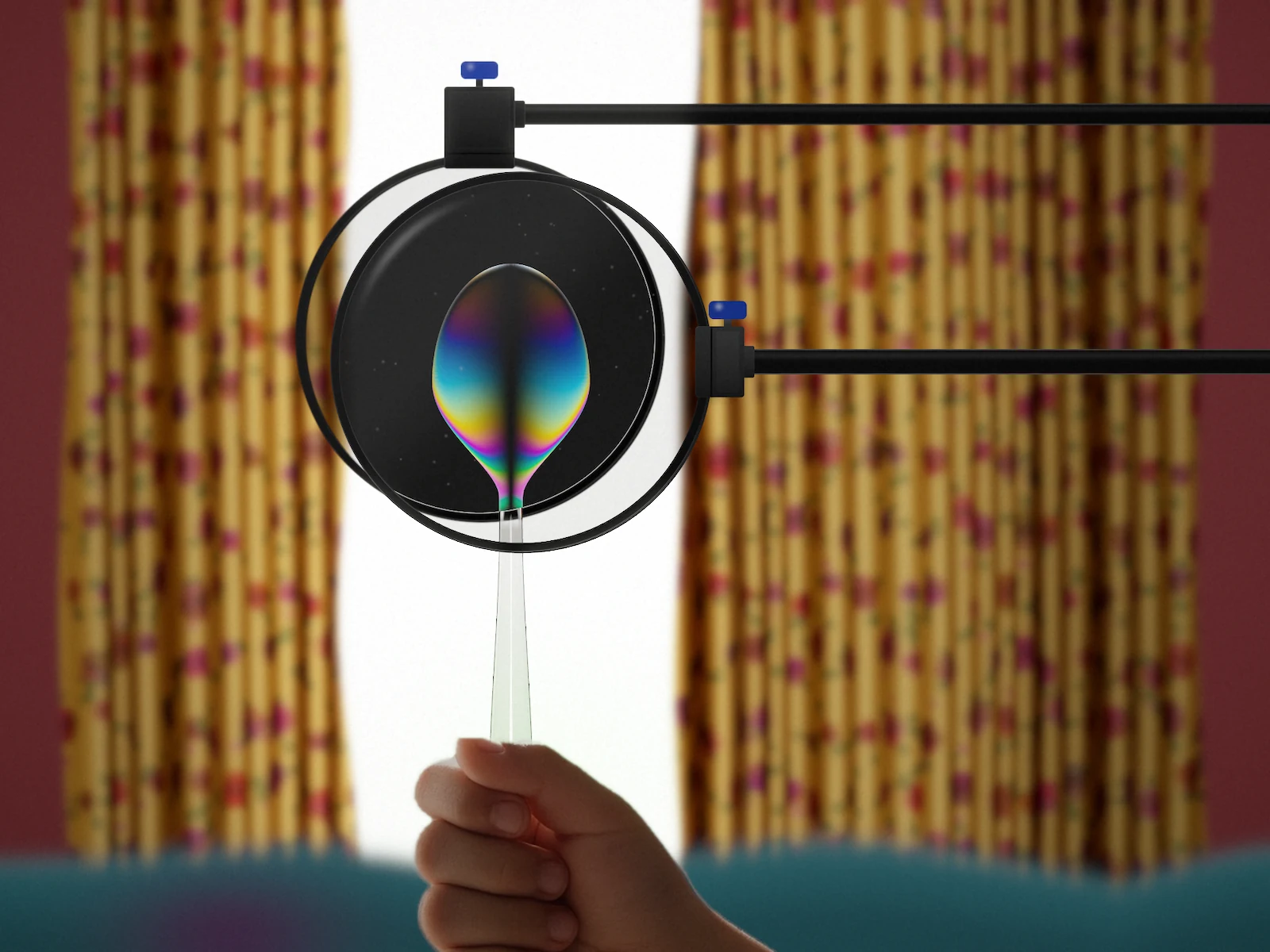
Illustration: two crossed filters on arms, a clear plastic spoon between them, daylight through the curtains behind. 3Plastic
A clear plastic spoon in the gap. The bowl shows molded-in rainbow bands near the neck. Some plastics and ordinary window glass stay dark.
- 4
Look
Crossed filters make the stress bands bright. Turn the spoon or the front filter in the plane and watch the pattern swing.
Bear with me
Mechanism
For the arrows: a dashed orange arrow is light traveling, and its length is not how bright the light is. A thin orange arrow with a head on both ends is a direction, the way the light is wiggling, or the two directions inside the plastic. It is not a push. The only pushes are the thick orange arrows in panel 3, and those have one head. Panel 1, "Crossed filters go dark". One drawing, read left to right in the order the light travels: a lamp, an adult holding the first polarizing sheet in front of it, an empty place for the plastic, the second sheet held the same way, and an eye. That empty place is the check with nothing in the gap yet. A lamp's light wiggles every which way. An ideal first filter keeps about half of it, the half that was already wiggling the right way. The second filter's direction is at right angles ("crossed"), so it has nothing left to pass; the light that did not get through was absorbed there. The small dark circle before the eye is the dark that eye sees. Turn them so the two directions line up, and the field goes bright again. The crossed way is the dark field you want before you add the plastic. Panel 2, "A lag that makes color". Same train: lamp, filter, specimen, filter, eye. The fork stands in the place that was empty. A little color is drawn on the fork. Lift either filter off and the color is gone. The fork was not painted, and it is not glowing. The color is the light that the second filter lets through to the eye. The plastic has two directions of its own, from chains lined up when it was molded. Light wiggling along those directions moves at two different speeds, so one part falls behind (a lag). The second filter keeps the across part of the wiggle and throws the rest away. White light is many colors at once, and each color lags by a different fraction of its own wave, so each color gets through by a different amount. What reaches your eye is no longer white. A band of one color is a band of one lag: the index difference times how thick the plastic is. The patches on this fork are molded-in lag, often near the neck and the base of the tines. Panel 3, "Squeeze, and bands shift". Same train. Two grey fingertips pinch the handle across its width. Left, "sitting": mostly dark, one faint patch leftover from molding. Where the lag is nothing, crossed filters stay dark, same as the empty gap. Right, "squeezing": two thick arrows push into the plastic from both edges. They match because the piece is not accelerating. Between the fingers the color goes edge to edge, the same across the width. This pinch does not pack extra bands at a fingertip. Above and below the fingers the extra color fades. Let go of a gentle squeeze and the extra bands fade. The molded-in color stays, because that lag was frozen in when the fork was made.
Numbers
Visible light is roughly 400 to 700 nanometers. One full wavelength of lag is one fringe order. Nothing on the sketch is a numbered order for a fork. The fork's plastic, its thickness, and its stress are not one number. An ideal line polarizer keeps half the light from a lamp, and two ideal polarizers at right angles keep none. Brightness after the second one, for light that is already polarized, goes as the square of the cosine of the angle between the pass directions. Real sheets keep less than half, and the dark field is "as dark as it will go." The lag is the index difference times the thickness. In the elastic range, for light going through the thickness, that index difference is proportional to the difference of the two principal stresses in the plane. The constant depends on the polymer, and the sign (which direction is faster) is not the same for every plastic. No constant is printed here. On panel 2 the two diagonal arrows match, and each geometric tip-to-tip length is the up-and-down arrow divided by the square root of 2. That is the 45 degree split, not a measured stress. On panel 3 the two pushes are the same length because the handle is not accelerating. The 1 cm bar is the drawing's scale. The short side of that handle is drawn as 1.5 cm. The sim states its own constants, because it has to compute a picture. The body is a strip 15 mm across the pinch, 40 mm along the handle, and 2 mm thick. Polycarbonate-ish C is 7e-11 Pa^-1. The added pinch is uniaxial compression that depends only on position along the handle: the same pressure all the way across the width, a gaussian of width 6 mm, strongest at the center. At the top of that slider the center principal-stress difference is 8 MPa, and that center lag is about 1120 nm. Residual molding is a separate illustrative tensor, added before the principals are taken. It does not scale with the slider. Color uses 16 wavelengths from 400 to 700 nm, a D65-like spectrum, and the CIE 1931 matching functions, then sRGB. Both pass axes are sliders, degrees from horizontal.
Go deeper
Take one filter away. The fork looks clear. Put it back, cross them, and the color returns. That is the whole check against paint and against a glow. Turn the fork, or turn the front filter, in the plane setup (daylight through the window, the lamp sketch, or a white screen with one lens held in front). You may see a black streak that swings with the turning and barely cares if you squeeze a little. That streak is direction: the plastic's two directions lined up with the filters, so the second filter still blocks the light, even where the stress is not zero. It is called an isoclinic. The sketch does not draw one. The shape depends on the piece, and a guessed curve would be a false map. Clear tape is the same trick, frozen at the factory. Each extra layer adds lag, so the color steps. The sketch does not say how much a layer adds. It depends on the tape. Tempered glass, the kind in a car window, can show a fixed pattern. That pattern was put in when the glass was made. It will not squeeze away.
Name for this
Polarized light. Birefringence and photoelasticity (stress shows up as a lag between two directions of the light).
Try it: dark field, then squeeze
Turn the front filter until the field is as dark as it will go, then add a pinch. Same crossed-filter idea as the window setup.
lamp → filter → specimen place → filter → eye
lamp
white light
filter
polarizer
specimen place
handle
filter
analyzer
eye
below
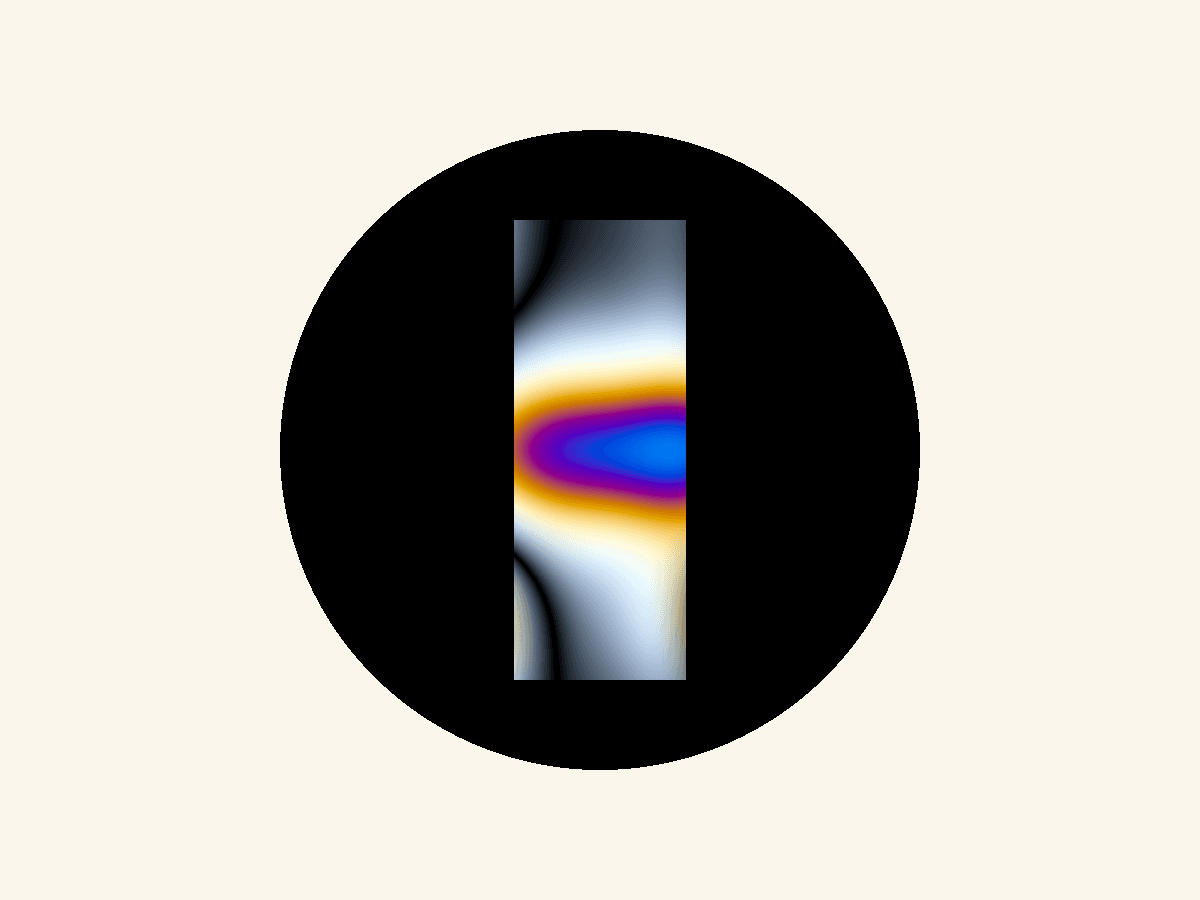
Crossed filters. No stress in the piece, so the eye sees a dark field.
90° between the filters · crossed · center lag 0 nm
The specimen is a strip 15 mm across and 40 mm along the handle, 2 mm thick, a stand-in for the fork handle. Light goes through the thickness. The pinch is across the width. That pressure is strongest between the fingers and is taken as the same all the way across, so the picture does not pack extra bands at each fingertip. Residual is an illustrative molded-in pattern, stronger near the gate and the long edges, and it does not change when the pinch does. Polycarbonate-ish plastic. Line polarizers only. Color uses a few wavelengths. A dark region that stays put while the stress changes is direction: the piece's axes lined up with the filters.